
The Big Bouncy Turtle, Mark Volman has Left the Stage...

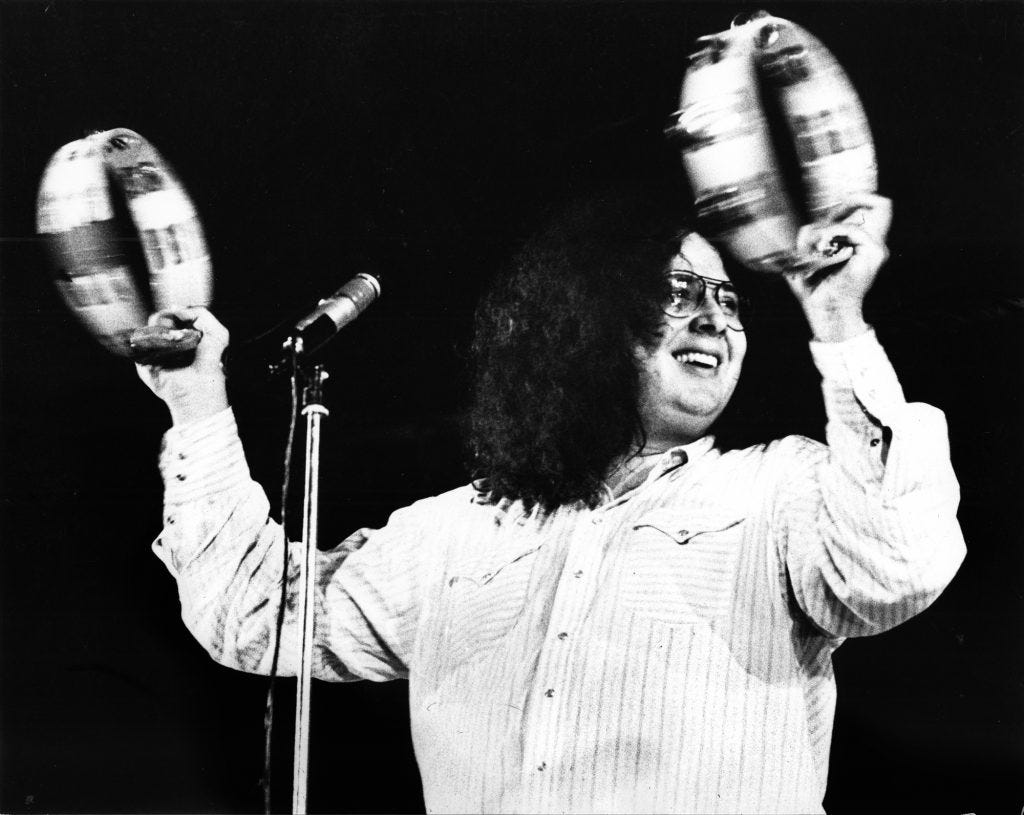
Upon hearing the sad news that Mark Volman (who was diagnosed with Lewy Body Dementia (LBD) in 2020) has left us, I’ve dug this old piece published by the NY Observer in April 2017, out of the cyber mothballs.
Still Sappy After All These Years: The Turtles’ Happy Together Turns 50
Can a 50-Year-Old Pop Album Stop Us From Destroying Each Other?
Perhaps the downfall of our society and the dark age we're currently living in might just have something to do with the music we listen to.
I have this theory about harmony singing. Corny as it might seem, I believe that human voices weaving melodies together can help to ease the differences between us and create unexpected bonds. I’ll even go so far as to say that harmony might actually be integral to our collective happiness and survival as a species. No, I was never a member of the Glee Club, and I’m not suggesting a group hug on Capitol Hill between the Dems and Repugs, ending with a hearty sing-a-long of “Kumbaya” (which BTW the Senate of Georgia has recognized as a “State Historical Song”), but perhaps the downfall of our society and the dark age we currently find ourselves in, might just have something to do with the music we listen to. Perhaps it’s just chicken and egg. Either the times create the soundtrack of our lives, or the music is a direct mirror of our troubled souls. Don’t worry, I’m not about to launch into some cranky tirade about how music has sucked since the death of the big band or the invention of the electric guitar, or the how the drum machine has mugged the groove of its soul…. It’s more an issue of buoyancy and breath.
Although the sixties were fraught with conflict, from the civil rights struggle, which gave us robust anthems like “We Shall Overcome,” and “Don’t You Let Nobody Turn You ‘round,” along with Bob Dylan’s sharply articulated protest hymns like “Masters of War” and “With God on Our Side” that questioned the hypocrisy of our “Great Society” and our role in the Vietnam War, there was an undaunted “keep the faith, baby” feeling of optimism that fueled the battle against racism, and an unjust war, and ultimately helped drive a corrupt president from the Oval Office.
While the Turtles initial success came from riding the brief folk-rock fad in 1965 with their ebullient covers of Dylan’s “It Ain’t Me Babe,” and P.F. Sloan’s “Eve of Destruction,” their message was considerably lighter, a blast of cheery hope, more like The Mary Tyler Show theme song, assuring you, “You’re Gonna Make It After All.” As the late/great French novelist Gustave Flaubert once put it, “The principal thing in this world is to keep one’s soul aloft.” Curiously the Turtles’ brand of sonic optimism has endured for decades, helping the world weary counteract the harsh realities of the day.
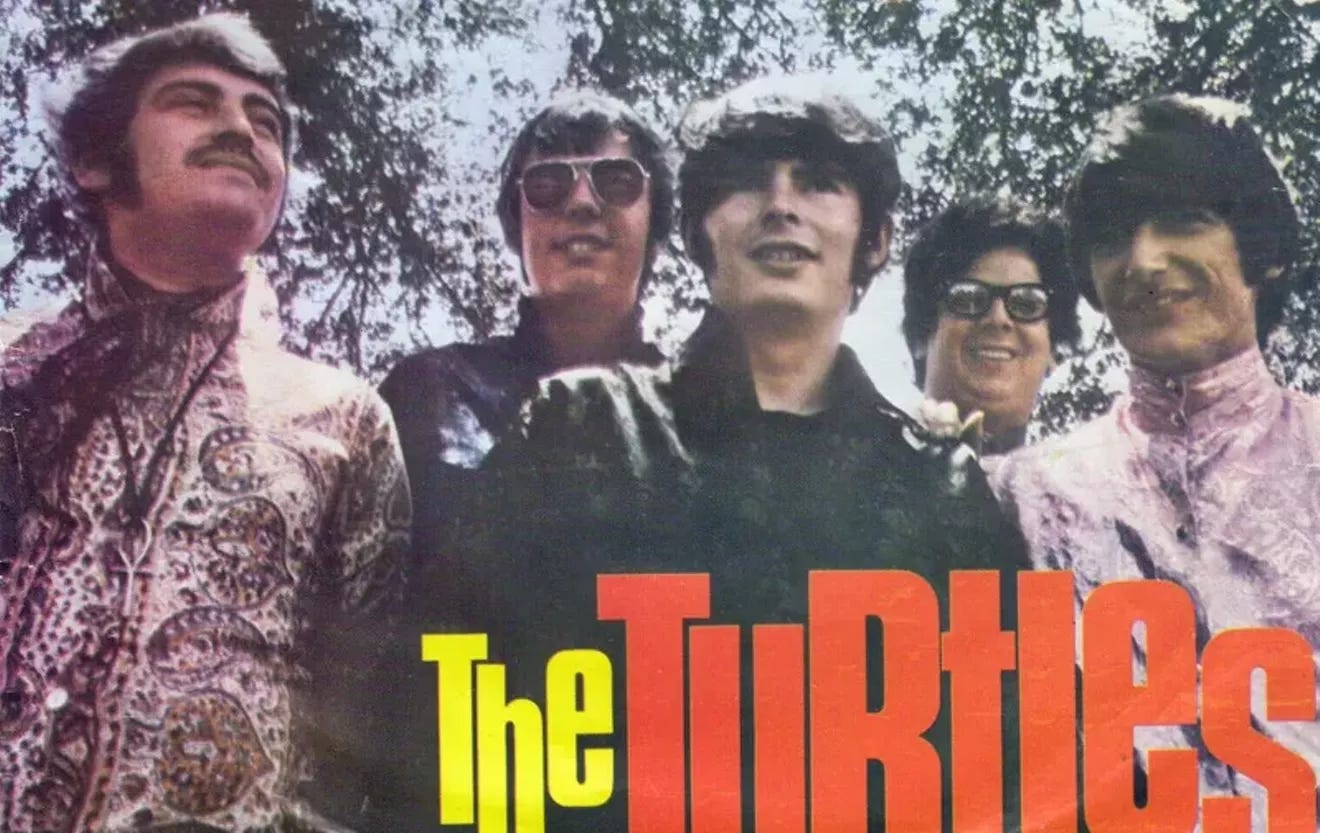
While hardly musical innovators, the Turtles never missed an opportunity to take it over the top. Mark Volman and Howard Kaylan were a pair of chubby, lovable dorks who could really sing. According to Kaylan’s hilarious memoir Shell Shocked, a nasty John Lennon picked on their rhythm guitarist Jim Tucker for his square appearance to the point where he quit the Turtles following the remaining dates of their British tour. The traumatized “Tucko,” as Lennon dubbed him, then flew home from London, never to play music again. Like Buddy Holly before them, the Turtles managed to secure a seat at the rock ‘n’ roll lunch table for millions of awkward teenage boys, no matter how geeky they looked.
The Turtles were essentially a singles band. Beyond their 1967 release, Golden Hits which found its way into nearly everybody’s record collection (no matter how cool they thought they were), I never heard any of their LP’s other than their totally whacked 1968 “concept album” The Turtles Present the Battle of the Bands, a hilarious hodgepodge of tunes played in a variety of styles from bluegrass, to psychedelic rock to surf music and hard rock all sung by the Turtles, posing as fictitious groups with absurd names like Fats Mallard & the Bluegrass Fireball and the Atomic Enchilada.
My friend, the English professor Dominic Ording, who has an unbound appreciation of all things pop has fashioned a slogan by slightly tweaking the “silent” Indian guru Meher Baba’s famous saying, “Don’t Worry, Be Happy” into “Don’t Worry, Be Sappy.” It seems to perfectly sum up the Turtles.
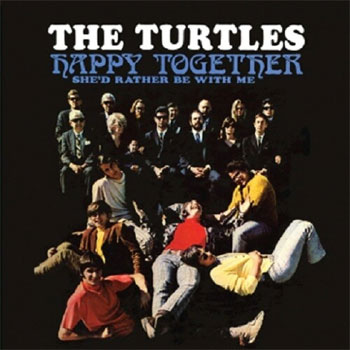
Released on April 29th 1967, Happy Together kicked off with the insidiously catchy “Makin’ My Mind Up” which teemed with an unbridled optimism and a bah-bah-bah-bah vocal arrangement typical of mid-sixties AM radio pop bands like the Association and Spanky & Our Gang.
Written by soundtrack czar John Williams & Leslie Bricusse (the British composer and lyricist who wrote music for dozens of popular plays and movies including Willy Wonka & the Chocolate Factory) “A Guide for the Married Man” was the theme song to the (now cult classic) 1967 movie of the same name, which starred a cast of “fourteen swingers” (including Walter Matthau, Jayne Mansfield, Lucille Ball and Wally Cox to name a few). The tune, not surprisingly was another big production featuring a flurry of giddy bah, bah-bah-bah’s.
With its gently whispered vocals, the navel gazing “Think I’ll Run Away” was Kaylan and Volman’s only songwriting collaboration on the album. “Life should show us so much more, think I’ll run away,” Mark and Howard sing over a lilting string section. Like the Beatles’ “She’s Leaving Home,” from Sgt. Peppers, which was about to be released in a matter of weeks, “Think I’ll Run Away” was very much as song of its day. Searching for an alternative to the 9-5 world they were being groomed for by their parents, schools and churches, a generation of baby boomers had already begun to rebel against The Establishment. The upcoming “Summer of Love” would inspire thousands of disaffected youth all over the country to flock to San Francisco with (or without) flowers in their hair, in search of a fleeting utopia where free love and dope briefly reigned.
Written by Kaylan and the band’s bassist/rhythm guitarist Al Nichol, “The Walking Song” meanders about, filled with unexpected musical detours while “Me About You,” the first of three Garry Bonner & Alan Gordon songs on the album, features a fanfare of triumphant trumpets followed by that familiar guitar intro and marching snare drum. Bonner & Gordon’s masterpiece, “Happy Together” will forever define the Turtles. Kaylan believed the song, “was going to be a hit. We honed and developed it over months on the road,” he said in an interview with journalist/author Harvey Kubernik. “I’ve never had the luxury to take something on the road for eight months and work it and rework it and just fine tune it. I didn’t know ‘Happy Together’ would be that huge,” he admitted.
After bumping the Beatles’ “Penny Lane” out of first place on the charts, the Turtles would appear on The Ed Sullivan Show on May 14th, 1967, looking like a wedding band on acid. As Kaylan croons in a bright striped jacket, white pants, bow tie and Elvis sideburns, Mark Volman, in a satin orange frock, kicks his legs high and twirls a French horn about in a manner which no instrument should be handled, while occasionally slapping it like a tambourine. Howard makes a sincere effort at lip-synching the tune as the rest of the band… well, I sure hope they were stoned.
The song contains Bonner & Gordon’s classic lyric, “call you up, invest a dime,” which sent an entire generation running for the nearest phone booth to drop a coin in the slot to speak intimately to their sweethearts. With a roll of John Barbata’s snare drum the chorus explodes, gushing with a relentless optimism as Kaylan and Volman sing, “baby the skies will be blue, for all my life.” Beyond being a catchy pop confection, there’s a reason this song remains robust fifty years later. No matter how sticky the song’s sentiment might be, and no matter how cynical and jaded we’ve become all these years later, there’s still an eleven-year old of pure heart that dwells within (at least some of) us who desperately wants to believe in the promise of “Happy Together.”
“She’d Rather Be with Me” another Bonner & Gordon tune, was the B-Side to “Happy Together,” and the band’s follow-up hit, (peaking at number three on the Billboard charts) complete with a swirling carnival of blaring horns, and plenty of the band’s now trademark bah, bah, bah’s.
Eric Eisner’s “Too Young to Be One” briefly borrows the melody of the nineteenth century Shaker hymn “Simple Gifts” until morphing into typical sixties radio-friendly folk-rock. A lightly strummed acoustic guitar quickly gives way to a Tonight Show style swing arrangement that became typical of sixties horn bands like Chicago and (the post Al Kooper) Blood, Sweat & Tears.
Written by Al Nichol, “Person Without a Care” portrays just that, a happy-go lucky guy skipping down the street, but you have to wonder what will be his fate after hearing “wedding bells.”
Curiously the album includes an introspective ballad, “Like the Seasons,” an early offering by Warren Zevon (who had previously written “Outside Chance” for the band). Featuring an acoustic guitar and lush string arrangement, the song lacks any of irony and attitude the “Excitable Boy” would soon become famous for.
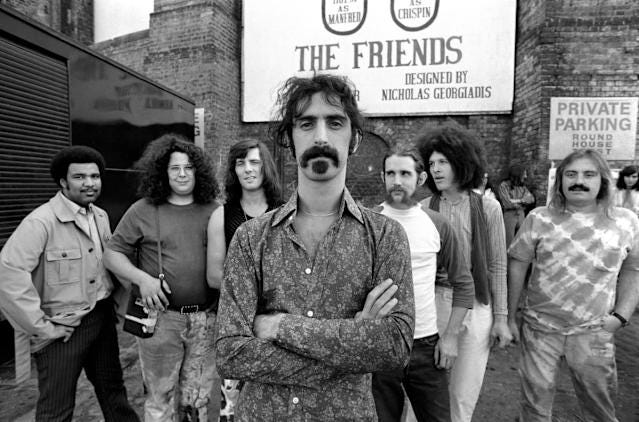
(The Phlorescent Leech and Eddie with Zappa. I saw one of the Fillmore shows later released as Mothers- Fillmore East – June 1971 and will never forget how outrageous Volman and Kaylan were on “The Mud Shark,” and “What Kind of Girl Do You Think We Are?”).
Perhaps the first inkling of the outrageous duos by the Florescent Leech and Eddie (as Kaylan and Vorman soon became known on their solo albums, as well as singing with T. Rex and Frank Zappa’s reformed Mothers of Invention) came with Kaylan and Nichol’s quirky “Rugs of Woods and Flowers,” sung in a brash, cheeky cabaret style, and drenched in a whirlwind of sound effects and applause as the song fades out.
The 2011 Sundazed re-release CD of Happy Together included three additional tracks: “She’s My Girl,” “You Know What I Mean,” another Bonner & Gordon composition and Howard Kaylan’s “Is It Any Wonder.”
So how does the album hold up fifty years later? Well, I suppose that depends on what kind of gum you’re chewing. Happy Together remains an excellent representation of 1960’s pop, packed with soaring voices, spiraling strings and booming brass. But it’s no expense-spared production by Joe Wissert, (later known for his work with Earth, Wind & Fire, Helen Reddy and the late/great Boston blues/rocker J. Geils) had a way of drowning out some of the less memorable tunes in the batch.

Mark in more recent years…
As a side note (with a topping of self-glorification)… One of my favorite moments in being a music writer came following the publication of this article, when Howard Kayaln sent me an email thanking me for the piece, adding that he would “read it every morning with his corn flakes for the rest of his life.”
So glad you mentioned the Fluorescent Leech and Eddie iteration. Always thought Volman was the Fluorescent Leech and Kaylan was Eddie.
Great article. I never (still don’t) understand why Zappa was attracted to them…..yet it really worked despite my shortcomings!